VN
VN
About TKT
TKT (Teaching Knowledge Test) is one of Cambridge English Qualifications for teachers. It tests knowledge of teaching principles and practices for English language teaching.
A TKT qualification shows solid understanding of language teaching concepts. This is ideal for teachers at B2 CEFR level or above seeking professional development.
TKT includes core Modules 1–3 and specialist modules: CLIL and Young Learners. Modules can be taken separately or combined.
Reason to choose TKT
- Internationally recognized teaching qualification from Cambridge that validates your knowledge of English language teaching methodology.
- Modular structure (Modules 1–3, CLIL, Young Learners) allows you to focus on the area’s most relevant to your current job and career goals.
- Suitable for both new and experienced teachers who want a solid theoretical foundation without having to take time off for a full-time practical course.
- Enhance your CV and can improve your chances of promotion, higher salary, or recruitment by quality schools and language centres.
- Provides excellent preparation for more advanced teaching qualifications such as CELTA or Delta, acting as a clear first step in your professional development.
TKT Exam format
TKT consists of separate modules, each a 1 hour 20 minutes paper with 80 multiple-choice/matching questions (1 mark each). No speaking or writing assessed.
| Module | Content | Exam format | Time | Purpose |
| Module 1 | Language and background to language learning/teaching | 80 questions | 80 minutes | Tests describing language, skills, teaching/learning theories |
| Module 2 | Lesson planning and use of resources | 80 questions | 80 minutes | Covers planning, activities, aids like PPP, TBL |
| Module 3 | Managing teaching/learning process | 80 questions | 80 minutes | Focuses on classroom management, learner needs |
| CLIL | Content and Language Integrated Learning | 80 questions | 80 minutes | For teaching subjects through English |
Module 1
This module tests candidates’ knowledge of terms and concepts common in English language teaching. It also focuses on the factors underpinning the learning of English and knowledge of the range and functions of the choices teachers have at their disposal to cater for these learning factors.
| Exam parts | Description | Tasks | Questions | Point |
| Part 1 | Describing language and language skills | Multiple choice, matching | 6 tasks, 40 questions | 1 point/ correct answer |
| Part 2 | Background to language learning | Multiple choice, matching | 3 tasks, 15 questions | 1 point/ correct answer |
| Part 3 | Background to language teaching | Multiple choice, matching | 4 tasks, 25 questions | 1 point/ correct answer |
Module 2
This module focuses on what teachers consider and do while planning their teaching. It also considers the linguistic and methodological reference resources that are available to guide teachers in their lesson planning.
| Exam parts | Description | Tasks | Questions | Point |
| Part 1 | Planning and preparing a lesson or sequence of lessons | Multiple choice, matching | 6 tasks, 40 questions | 1 point/ correct answer |
| Part 2 | Selection and use of resources | Multiple choice, matching | 6 tasks, 40 questions | 1 point/ correct answer |
Module 3
This module tests teachers’ knowledge of what happens in the classroom in terms of the language used by the teacher or learners, the roles the teacher can fulfil, and the ways in which the teacher can manage and exploit classroom events and interactions.
| Exam parts | Description | Tasks | Questions | Point |
| Part 1 | Teachers’ and learners’ language in the classroom | Multiple choice, matching | 6 tasks, 40 questions | 1 point/ correct answer |
| Part 2 | Classroom management | Multiple choice, matching | 6 tasks, 40 questions | 1 point/ correct answer |
TKT: CLIL
This module tests knowledge of the aims and rationale of a CLIL approach. It covers the planning, teaching and assessment of CLIL. It also focuses on teachers’ awareness of learning demands and support strategies for learners in CLIL programmes.
| Exam parts | Description | Tasks | Questions | Point |
| Part 1 | Knowledge of the principles of CLIL | Multiple choice, matching | 4 tasks, 25 questions | 1 point/ correct answer |
| Part 2 | Lesson preparation in a CLIL context | Multiple choice, matching | 4 tasks, 25 questions | 1 point/ correct answer |
| Part 3 | Lesson delivery | Multiple choice, matching | 3 tasks, 20 questions | 1 point/ correct answer |
| Part 4 | Assessment | Multiple choice, matching | 2 tasks, 10 questions | 1 point/ correct answer |
TKT exam result
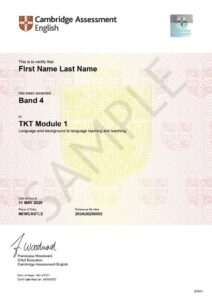
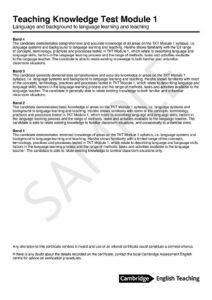
There is no Pass or Fail. Results are reported in Bands 1–4, with Band 4 being the highest.
| Band score | Description |
| Band 1 | Limited knowledge of the content areas tested |
| Band 2 | Basic but systematic knowledge |
| Band 3 | Breadth and depth of knowledge |
| Band 4 | Extensive knowledge |
TKT sample exam
Who accepts TKT
Cambridge teaching knowledge tests are recognised by over 25,000 universities, employers and governments around the world. Our teaching knowledge tests can improve employment opportunities, and because they are globally recognised, can increase your choices for work.